Istanbul, 2026. Prof. Dr. Mehmet Veli Karaaltın participated as a senior training instructor at the 2026 Yüz ve Rinoplasti Kadavra Kursu (Face and Rhinoplasty Cadaver Course), organized under the umbrella of TPRECD (Türk Plastik Rekonstrüktif ve Estetik Cerrahi Derneği). The hands-on dissection course brought together board-certified plastic surgeons and selected junior residents for an intensive day of cadaveric face lift training, focusing on safe surgical planes, deep-plane anatomy and modern rejuvenation techniques.
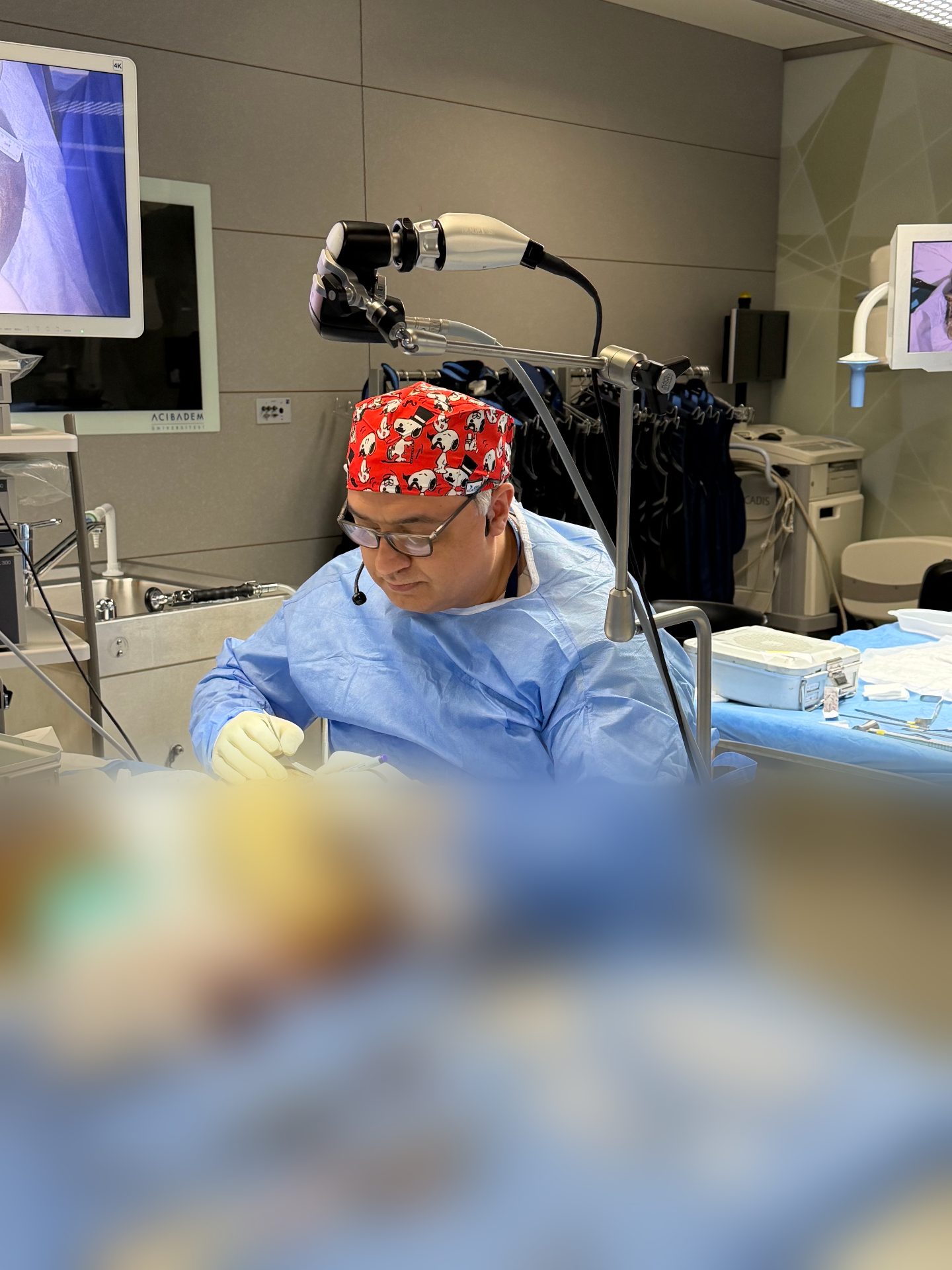
Why cadaveric training matters in modern face lift surgery
Face lift surgery has evolved from skin-only procedures to advanced deep-plane and SMAS-based techniques that demand intimate knowledge of facial anatomy. Cadaveric dissection courses remain the gold standard for training plastic surgeons in:
- Three-dimensional understanding of the SMAS, retaining ligaments and fat compartments
- Identification of facial nerve branches and their danger zones
- Safe dissection in the deep plane and sub-SMAS spaces
- Reproducible vector lifting that delivers natural, long-lasting results
What Prof. Dr. Karaaltın taught at the course
As an internationally recognized face lift surgeon and inventor of the K Face Lift, K Endoscopic Deep Plane and EndoChor® implant systems, Prof. Karaaltın led dedicated stations on facial anatomy and safe-zone surgery. His teaching focused on:
- Landmark anatomy of the temporal, midface and cervical regions
- Danger zones of the facial nerve — particularly the temporal (frontal) branch and marginal mandibular branch
- Reliable surface markings to predict the course of motor branches before incision
- Safe entry into the sub-SMAS and deep plane without compromising the nerve
- The role of fixation and vector control in achieving natural rejuvenation
The Polygon Zone: a proprietary concept for safer, more natural face lifts
A central highlight of Prof. Karaaltın's training was his original anatomical concept — the Polygon Zone. Developed through years of cadaveric study and surgical practice, the Polygon Zone is a defined geometric area on the lateral face that:
- Maps the safest surgical corridor between the temporal branch of the facial nerve and key retaining ligaments
- Allows the surgeon to release ligamentous attachments precisely without traversing nerve-rich territory
- Standardizes deep-plane elevation, reducing variability between cases
- Adds an extra layer of safety by keeping dissection within predictable boundaries
- Improves naturality by enabling true vertical vector repositioning of the SMAS, midface fat and platysma — without the over-pulled, lateralized look of traditional lifts
Course attendees performed the Polygon Zone dissection step-by-step on cadaver specimens under Prof. Karaaltın's direct supervision, observing how the technique protects the facial nerve while achieving deeper, longer-lasting tissue repositioning.
Knowledge transfer to the next generation of plastic surgeons
Beyond demonstrating his own techniques, Prof. Karaaltın emphasized the importance of repeatable, anatomy-based face lift surgery for junior plastic surgeons. Key teaching messages included:
- Always operate from anatomy, never from habit
- Mark danger zones before any incision
- Choose the deepest safe plane that achieves the desired vector
- Fixation must respect natural facial mimetic dynamics
About TPRECD and the 2026 course
The Türk Plastik Rekonstrüktif ve Estetik Cerrahi Derneği (TPRECD) is the national society of plastic, reconstructive and aesthetic surgeons in Turkey. The 2026 Yüz ve Rinoplasti Kadavra Kursu is one of its flagship hands-on educational events, combining face lift and rhinoplasty cadaveric training with lectures from Turkey's most experienced facial surgeons.
Why this matters for patients
Patients considering a face lift in Istanbul benefit when their surgeon actively teaches and refines technique at this level. Continuous cadaveric training ensures that procedures performed at Dr. Karaaltın Clinic reflect the most current, anatomically validated and safest approaches to facial rejuvenation — delivering results that look natural, balanced and lasting.
Learn more about the K Face Lift or book a consultation with Prof. Dr. Mehmet Veli Karaaltın.
Considering this procedure?
Book a private consultation with Prof. Dr. Mehmet Veli Karaaltın for a personalised surgical plan.
Speak to the clinic
Patients travel from the UK, Ireland and the United States for treatment in Istanbul. Video consultations are held before you book any travel.
Teşvikiye, Sakayık Sk. No:47
34365 Şişli / Istanbul, Turkey